
Walk down the bolt aisle at any hardware store and you’ll find yourself staring at row after row of fasteners that all look roughly similar but definitely are not. Grab the wrong one and you’re looking at a loose joint, a stripped hole, or in serious cases, a safety problem you really don’t want to deal with. The good news is that once you understand what each bolt type is actually designed to do, choosing the right one becomes a whole lot simpler.
Here’s a straightforward breakdown of the most common bolt types, what they’re best for, and how to make sure you’re reaching for the right one every time.
Hex Bolts: Start Here for Almost Everything
If there’s one bolt that earns the title of “most versatile fastener on the shelf,” it’s the hex bolt. That six-sided head grips easily with a standard wrench or socket, and these bolts are available in just about every size, material, and strength grade you can think of.
Hex bolts work for structural framing, machinery assembly, automotive repairs, furniture, plumbing connections, and more. Pair them with a nut and washer and you’ve got a strong, adjustable, removable connection. When someone asks “what bolt should I use?” for a general metal-to-metal connection, hex bolts are usually the right answer.
U-Bolts: When You’re Wrapping Around Something Round
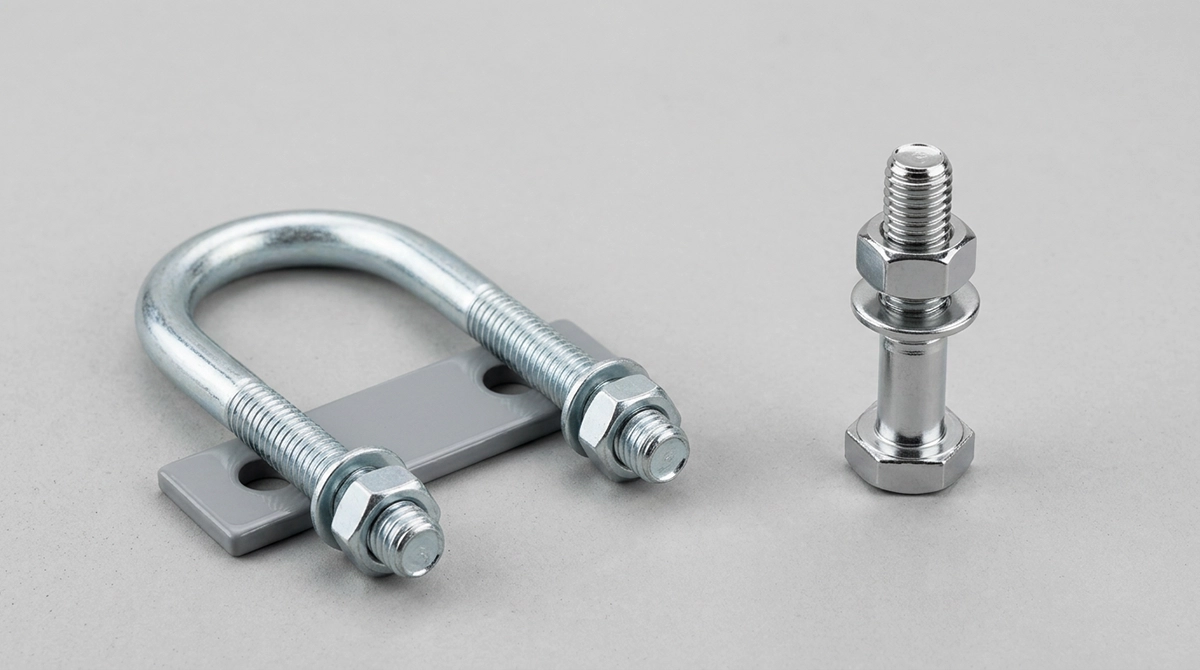
U-bolts have that distinctive U-shaped bend, with threaded legs on both ends. They’re made for clamping around pipes, tubing, conduit, or round bars and securing them to a flat surface or mounting plate.
You’ll find U-bolts holding pipe runs to structural members, securing exhaust systems in trucks, and mounting leaf springs in automotive suspension. When sizing one up, match the inside diameter of the bend to the pipe or object you’re clamping, and account for the thickness of any mounting plates when you’re figuring out leg length. If you’re working outdoors or in a wet environment, skip the plain steel and go with zinc-plated or hot-dip galvanized.
Carriage Bolts: Clean Look, Built-In Security
Carriage bolts have a smooth, rounded head with a small square neck right underneath it. When you drive one through a pre-drilled hole in wood, that square neck digs into the material and keeps the bolt from spinning while you tighten the nut from the other side. The smooth head can’t be gripped with a wrench, which means once it’s in, it’s not coming out easily from the outside.
That tamper-resistant quality makes carriage bolts popular for public installations like park benches, bike racks, and playground equipment. They’re also great for decking, fencing, and any wood project where you want a clean, snag-free surface. No one wants a protruding bolt head catching their sleeve on a park bench.
Lag Bolts: Heavy-Duty Wood Fastening Without the Nut
Lag bolts (also called lag screws) look like oversized hex bolts with coarse, sharp threads that bite directly into wood. You drive them with a wrench or socket into a pre-drilled pilot hole, and they grip the wood so firmly that no nut is needed on the other end.
These are the go-to fastener for securing deck ledger boards to houses, building pergolas, mounting heavy brackets to wood beams, and general timber framing work. They offer serious pull-out resistance that standard wood screws just can’t match. For anything outdoors, use galvanized or stainless steel to handle moisture and weather.
Eye Bolts: Your Rigging and Lifting Anchor Points
An eye bolt is exactly what it sounds like: a threaded shank with a circular loop at the top. They create reliable attachment points for ropes, chains, cables, and hooks.
In industrial settings, shoulder eye bolts handle lifting heavy loads like motors, steel plates, and machinery components. Shoulder-style eye bolts can handle angled loads up to 45 degrees, while plain eye bolts are strictly for straight, in-line pulls. Load ratings vary widely, and one thing worth knowing is that working at an angle reduces capacity significantly. At 45 degrees, you’re down to about 30% of the rated capacity. Never skip checking those load ratings.
Anchor Bolts: Fastening to Concrete
If you’re attaching something to a concrete foundation or slab, you need anchor bolts. These come in two main types: cast-in-place bolts (the L-bolt and J-bolt styles that go into wet concrete before it cures) and post-installed options (wedge anchors, sleeve anchors, and drop-in anchors that get drilled into existing cured concrete).
Wedge anchors are a solid choice for heavy loads and shear force applications. Sleeve anchors are versatile for general fastening. Drop-in anchors work great for suspending equipment from concrete ceilings, like ductwork or sprinkler systems. Match the anchor type to the load, the base material, and the environmental conditions.
Flange Bolts and Shoulder Bolts: Specialty Situations
Flange bolts look like hex bolts with an integrated circular flange beneath the head, acting as a built-in washer. That flange distributes load over a wider area and provides better vibration resistance than a standard hex bolt with a separate washer. They’re popular in automotive assemblies, pipeline connections, and anywhere vibration could work a fastener loose over time.
Shoulder bolts have a smooth, unthreaded cylindrical section between the head and the threaded end. That precision shoulder makes them ideal as pivot points, bearing surfaces, and guides in precision machinery, robotics, and aerospace applications.
Choosing the Right Material and Grade
Beyond the bolt type itself, material and grade matter. For most dry, indoor work, plain carbon steel is fine. For outdoor or mildly corrosive environments, go with zinc-plated or galvanized steel. Marine or chemical environments call for stainless steel 316.
On strength grades, the head markings tell the story. No markings generally means Grade 2, three radial lines means Grade 5, and six radial lines means Grade 8. The higher the grade, the higher the tensile strength, and the more appropriate for heavy structural or critical applications.
The Short Version
Before you grab a bolt off the shelf, run through these four quick checks: What am I fastening? What loads will it carry? What’s the environment like? What size and thread do I need?
Those four questions will point you to the right fastener almost every time. And when you’re not sure, the folks at My Main Supply carry the full range of bolts, nuts, and hardware you need, along with the knowledge to help you get the right one.
Contact My Main Supply:
Phone: 1-800-494-4794
Email: [email protected]
Get the right fasteners the first time, and your projects will hold together the way they’re supposed to.
